The Baritone
A story about perfect sound and imperfect listeners.

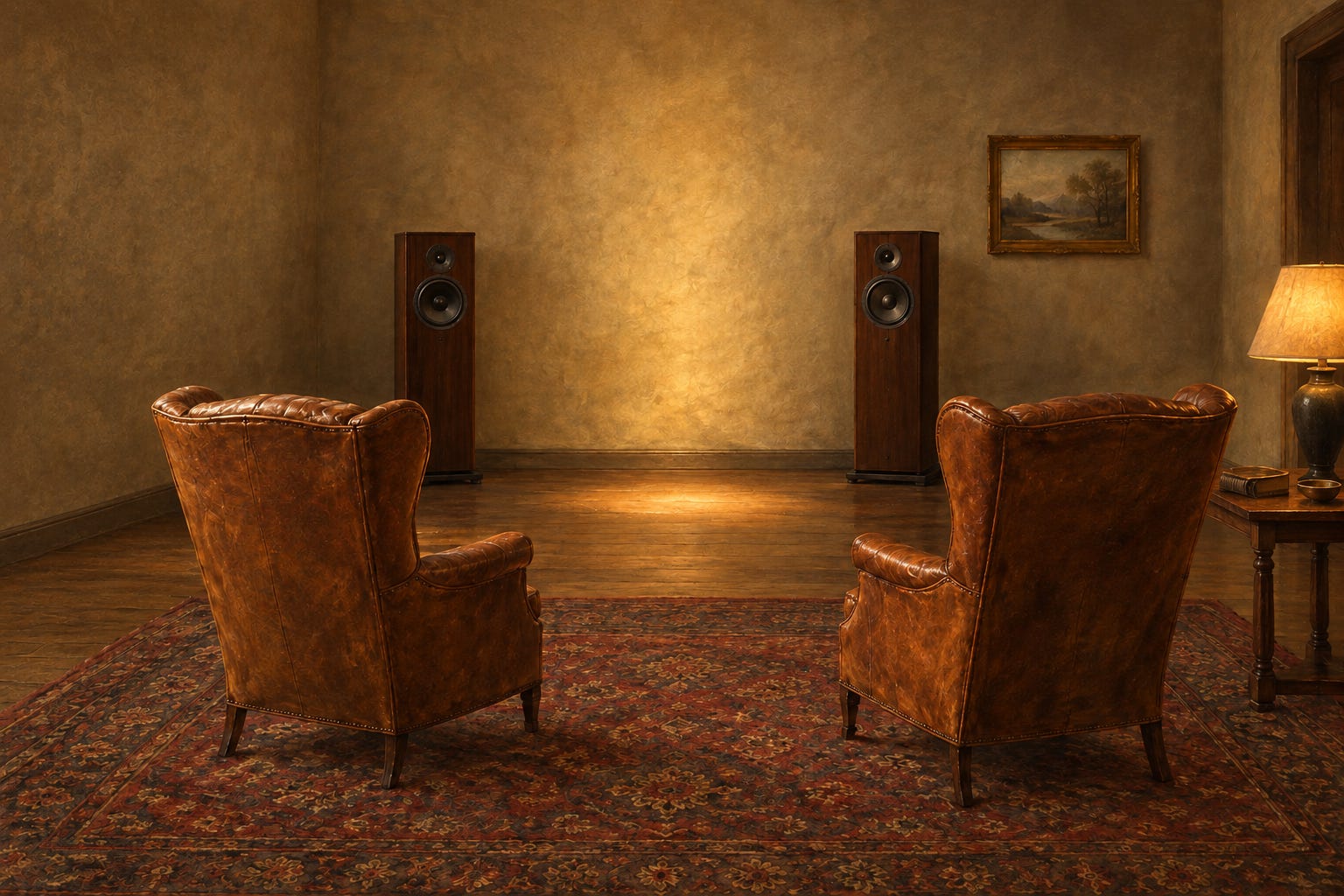
“Remember that singer I wanted you to meet? He’s waiting for us,” Chess said, walking to his music system.
Almost without thinking, I sank into one of the two wingback chairs facing the six-foot-tall speakers, the scent of leather filling my nose. Chess had spent his adult life building his music replication system, that’s what he called it, for his goal was to give you the equivalent of a live music experience, sans the headphones or earbuds.
He liked to say all the failures in fidelity happened before the music got to him. Meaning his setup reproduced verbatim what it received. Faultless. No more LPs, CDs, or even MP3s. Everything was in lossless digital files, like the ones used in recording studios.
“He’s a miracle. I’m going to impress you today, unless you’ve already heard his voice live, which you haven’t, of course.”
Chess loved to educate me, as though I were an aesthetic disaster. I wasn’t much a fan of classically trained voices, but he had promised this transcendental experience for weeks, so I went with it. “Remember, opera’s not really my thing.”
“No worries,” he said, lowering his brow and shaking his head. “This isn’t some hefty diva belting out an old Italian aria. This is pure. Nineteenth-century German art song. Wolf.”
He would often go on like this as if I understood what he was talking about. I would pretend to understand, for somewhere along the process, I’d feel different, perhaps more enlightened, but certainly less pedestrian.
I shifted in the chair. “What’s his name again?”
“You’ve forgotten already,” he chided. “Well, it’s not important if you can’t seem to remember it.”
Chess powered up the system. I waited for a hum from the speakers, or at least a crackle or a tone to let you know all was working, but there was nothing, only the chilling void of unadulterated silence. The hair on the back of my neck stood.
Chess smiled. “My, you are ready. But let’s wait for some music before we succumb.”
To say the space was soundproof would be an insult to Chess. The room was completely isolated. Most inconvenient to his guests, it was a tech-free environment. Except for his system, there were no electronics allowed, no phones, no screens. He permitted nothing with voltage inside the room. A friend told me he’d once made an exception for a pacemaker, but asked if the man could turn it off while inside. When the man said he couldn’t, Chess replied, “Pity.”
Now, the interior would surprise you. Chess believed the room should reflect sound as a normal living room would. Imagine you’re in someone’s parlor, and a singer stands by the piano and sings. That’s the sound he wanted, not something sterile and purified, devoid of ambiance. A paradox, really. So instead of sound-absorbing material, as you’d see in recording studios, he had plastered walls, pictures, chairs, an end table, a lamp, and an area rug with a Baroque motif. The lights were appropriately dim and warm. Incandescent only. Of course, he’d have preferred candlelight if it weren’t for that pesky carbon monoxide.
The sum effect? A sense of transport, as though you’d entered a sacred space, a cathedral, a mausoleum, the air brimming with what was, or what was yet to come.
I searched for something to fill the space. “So, he’s … German?”
“Of course.”
“Singing in German?”
“It’s Wolf.” His voice dripped with sarcasm. “But don’t worry. The words aren’t important. They simply serve as a medium to convey the musical expression. I mean, at some point you’ll want to understand the poetry, but right now I want you to fall in love with the voice. And you will.”
He looked at my hand. My fingers were drumming on the chair arm, so I stopped, my breath arrested for a moment. “What was he like?” I asked.
“Well, I didn’t know him, if that’s what you mean. But I learned he once threw his cufflink at an accompanist for rushing a coda. Poor man.”
“Yeah, I wouldn’t want to be on the receiving end of a cufflink.”
When he rolled his eyes, I got it. His sympathies were with the singer.
Finally, he came and sat in the armchair next to me. In one hand, he held the remote, and in the other, a printout of his collection with catalog numbers, the code he’d use to call up the track.
I squinted, but I still couldn’t read the words on the player. It was just a few feet further than I could make out.
“Patience. Only a few more seconds.” Chess punched at the buttons on the remote, grimacing and twisting his face in his quirky way.
Then he turned to me.
“He sang his last lieder in 1993 and died in 2012. But tonight, he’s alive again, and he’s going to sing for us. You’re going to hear a sound no one has heard for thirty-three years.”
I wiped my sweaty palms on my jeans and closed my eyes.
So much waiting.
Chess was right. The singer’s voice appeared, and it was just the baritone and me.
And he was alive once more, and I was alive. Maybe for the first time. Every sense seemed to be firing, beyond the sound itself. Overwhelming and frightening.
I looked over at Chess. His eyes were closed. He’d departed into some other realm, away from me, away from my Philistine sensibilities. And when he opened his eyes and looked at me, his patience seemed renewed, his zeal for art restored.
That’s when I understood, understood us. His patience was compassion, and I was hopelessly lost.
Discussion about this post