

ARC Feedback Preview
The Rushing
By Mark Mrozinski
I’d lived with the rushing since I was a young child, and now it was impossible to remember life without the numbing sound, like water pouring over a waterfall. Voices were hard to decipher above the noise. Some were pitched just so and disappeared within the waters. Now, at thirty-six, I knew nothing else.
The doctors worked for twenty years, first to eliminate the sound, and then they searched for a technology that would help. Their most recent attempt, a set of hearing aids the size of belt buckles, sat in my drawer unused. I was done with it all, had been for more than a decade.
Mom kept the story for me until I committed it to my own memory. But it was always her telling I remembered, not any recollection of my own. For my birthday, we’d gone out near the Idaho border to do what we loved most: hike, set up camp beneath the junipers, explore the desert trails, and of course, paddle the river.
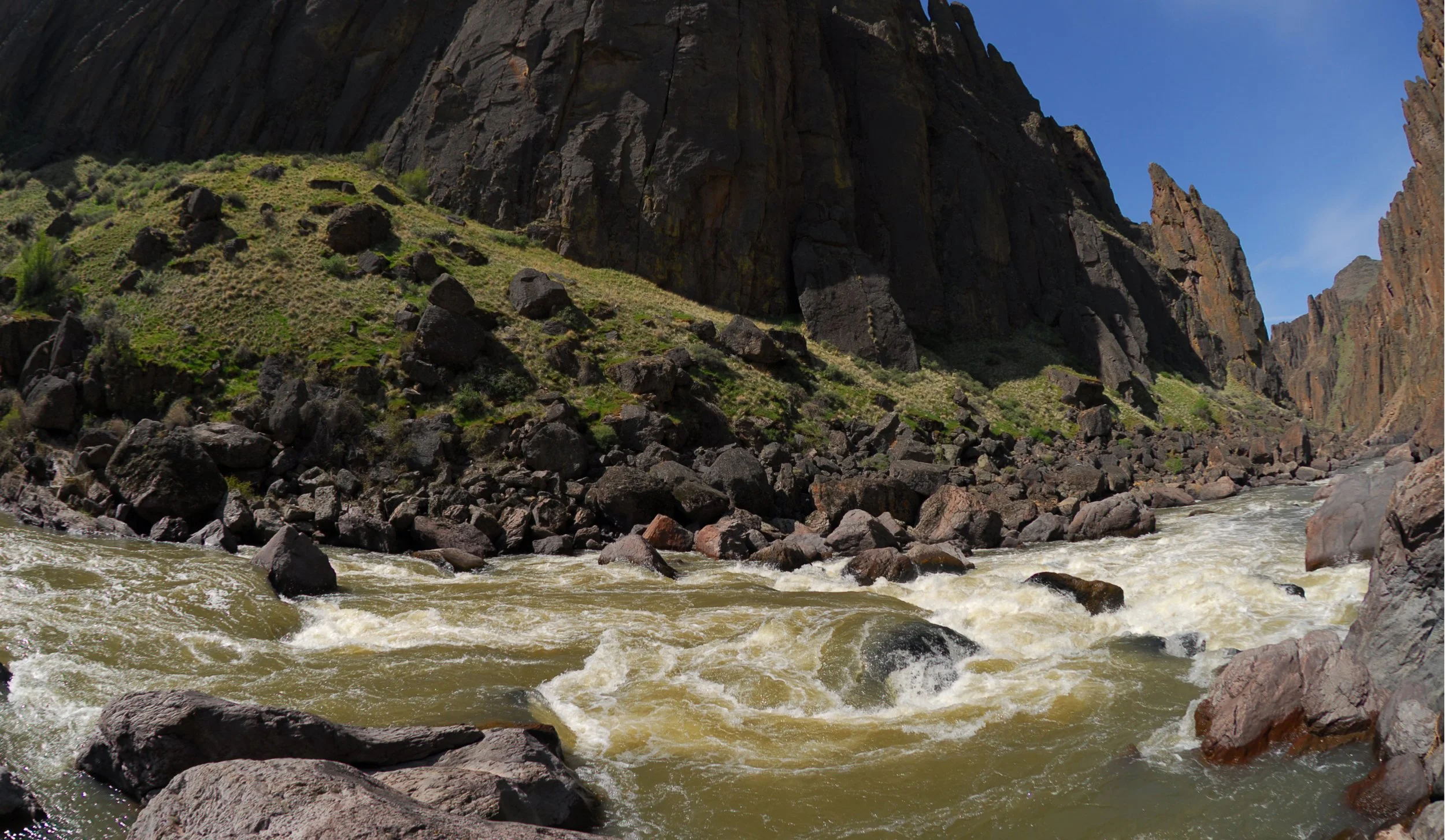
That morning, we were drifting through a placid stretch of the Lower Owyhee where it cuts a deep canyon in the rock. Then the river bent and dropped into unexpected rapids. In an instant, the glassy water turned to froth and capsized the canoe. We all went in the river, Mom and Pop, me, and my little brother, Jaime. Mom pulled me out of the water, lifeless and cold. With her own breath, she brought me back, while Pop swam after Jaime, who was swept downriver. I was five, so I don’t remember grieving for him. Rather, I lived within the shadow of my parents’ grief, with fewer smiles, less laughter.
That day on the Owyhee marked the start of Pop’s search for anything to numb his mind. Overnight, Portland’s most gifted architect became an alcoholic, and soon he was gone. It was as if Pop had died with Jaime that day. Then it was just Mom and me, and we missed Pop little. After the river, he’d been no more than a ghost in our house, and then one night, the ghost moved on to a more private dwelling to grieve in peace.
Since Mom passed a few years ago, there were moments I’d almost forgotten about the river, as one forgets the ground under one’s feet. And then, the rushing was there to remind me.
But today, my thirty-sixth birthday, the water subsided. I woke that morning, and the silence, it transformed my mind. Even my body felt different, somehow less dense. And then I heard things, an antique clock on the dresser ticking, the breeze in the trees through the open window, playing in the leaves.
This was not some random rearrangement within the biomechanics of my body or some healing process doctors had yet to name. This was propitious, even providential.
My phone buzzed on the nightstand. The first time I’d heard its sound. A text.
My admin from the office.
Someone called here for you and wouldn’t leave a message. I put him through to your voicemail.
I called the number to access the voicemail: You have one message. To listen, …
My throat tightened, and it took every ounce of my will to press the number.
Silence. Then …
“Justin … this is your dad. Yeah, it’s been … well, forever … since I left. Since … you know … the river. I don’t have the right to call, not after so long. But I remembered it’s your birthday, and I’m not young anymore. I don’t want anything. I just … well, we should talk.” He rattled off his number and ended the call.
The phone was shaking in my hand, and my cheeks were wet.
His voice was unfamiliar, raspy, and older, but it was him. I was sure.
The May weather was more pleasant than any recent spring, and I wanted a place where I could arrive late and scope him out. I’d have an excuse about work, impressing Pop with my important career. I chose an elegant sidewalk café in the Pearl District on Everett. Before today, I would never have chosen such a place for a conversation. The sounds, the voices, the traffic. It would all have been mixed within the rushing. Today, the sounds were discrete: the woman sweeping the sidewalk with her broom, a dog barking in an upper window, a delivery truck grinding its gears.
I parked and walked the few blocks to the café. It was Tuesday, and the lunch crowd was light. There was only one person seated at a sidewalk table. The man held a menu up close to his face, reading over the tops of his glasses. Pop.
His tattered canvas pants were stained with various shades of white and taupe. A painter. The shirt he wore, a T-shirt torn below one arm, looked thin and gray. Yet it was his face that held me. The blue eyes I remembered were now bloodshot and gray.
As I came to the table, my father stood and smiled, and I noticed the scar on his throat, and a memory came to me of Pop that day on the river, in the back of the canoe, smiling and paddling with a fat cigar in his teeth.
First, I was embarrassed for him, then I was ashamed I hadn’t considered what his situation might be, only of what I wanted him to see, through my words, through my attire, the restaurant, all of it. See what I’ve done without you. I don’t need you.
I was humbled.
“Justin. You look, I mean, you look great.” His eyes went glassy. “I just can’t believe it.” He coughed a few times and reached for his water glass. “Last time I saw you, you were what? Six?”
I leaned forward. “Yeah, so where’ve you been for thirty years?”
“Here and there. Had some bad years. Nowhere, really.”
“Then why call? Why now?”
He was looking out at the sidewalk, as though trying to find the words he’d planned to say, then he folded his paint-stained hands and set them on the table. “I’m dying. My doc say only a few months. But I didn’t come for your pity … or your money.” He gestured at my watch.
“What then?”
“What happened on the river.” His face was stolid.
“Mom told me what happened …”
“You know what she told you—what we both agreed on … and everybody else, we all agreed you didn’t need to know.”
The stone that had lain in my stomach since the morning had come alive and churned my insides. I put the napkin to my mouth.
“You okay, son?”
Pop reached out his hand, but I pushed it away and said, “What do you mean? Why would she lie?”
I swallowed and glanced down, then back at him. “Why did you leave?”
He glanced at his hands on the table, then met my eyes. “To protect you.”
“Protect me? From what?”
Pop’s face began to crumple. “I hated you.”
Let him say what he wants. Let him say it all, and it’ll be done, and I won’t ever need to see him again.
“… and I hated myself for it. That’s why I left. It was destroying me—destroying our family.”
I slammed my hand down on the table, rattling the silverware. “She didn’t run!”
The server appeared with menus.
“Just set them there,” I said, straightening my fork.
The man took in Pop for a moment, and Pop waved him away.
“We all have our breaking point, and mine came,” he said. “It was either self-destruction or leaving. It was difficult for everybody.”
“So you saved yourself. That’s noble!”
He set his heavy arm on the table, his expression falling.
Two servers were talking in low voices but retreated into the kitchen. Then I noticed the silence. No traffic. No one on the sidewalk. Just us. Perhaps for the last time.
His face had softened, all agency drained from it, but he still held my eyes.
And I said, “Tell me all of it.”
We’d driven the nine hours to camp near the Owyhee, and once out on the water, the world seemed far away. We relished the isolation, the self-reliance that the river demanded.
Pop had misjudged. Before the internet, maps were scarce, and we were five miles further downriver than we thought. The water was like glass, a perfect May day, and the sun was still behind the canyon, and a cool mist clung to the surface of the river.
“I heard a rushing coming from around a bend in the river, and I didn’t do anything. I just smiled and paddled. You and your brother were fighting up in front of the canoe, and your mother was trying to settle you.”
I felt the rolling of the boat, the splash of the waves now, reliving the day.
“The canoe was pitching and then turned sideways. I yelled for your mother to paddle left, but she’d grabbed Jaime by the arm to pull him away from you. But you didn’t want that, and you grabbed his other arm and pulled him back.”
He covered his face with his rough hands. “I yelled, ‘Sit down!’ Your mother was yelling too, and the river … and then your mother’s grip gave, and Jaime fell backward.”
He stopped, and his heavy breath rattled in his throat.
“Into the river?” I asked.
He nodded. “I couldn’t take my eyes off him, and when he slipped beneath the water, I lost myself, the boat, you, your mother, it all turned over and over, and I never got any of it back. I still see his desperate eyes in my sleep.”
It felt as though my heart had stopped. I reached for my water glass, but knocked it over instead. The tumbler fell to the sidewalk and shattered. The water ran across the linen tablecloth to drip on my lap.
The café staff was there cleaning up the spill. “Let me help you,” one of them said, and she reached toward my lap to stop the water, but I pushed her hand away.
“I’m fine,” I said, and I looked up at Pop. He was watching me as they finished sweeping the glass.
“So, it’s my fault?” I asked.
“I loved you boys so much. Then Jaime was gone, and I couldn’t look at you.”
I went cold, the hairs on my arm standing.
There were whispers when it happened, aunts, uncles, family friends, the kind that would stop when a child approached, and I took them for just that. But it was their looks. Even as a child, I felt … something in their stares. I’d been noticing stares ever since.
“Well, I am glad you told me.” The only words I could find, and once spoken, they sounded lifeless. The truth was, I didn’t know what I felt. The water had soaked through my trousers now and was cold on my thigh.
“I’m not telling you to make you feel bad. Something told me you needed to hear this now.”
“Seems selfish to tell me I’m responsible for Jaime’s death. You could have taken it with you … to wherever you’re going.”
He grabbed my arm, and the scar on his throat bobbed up and down as he struggled to speak. “I do not want hate to eat you up, like it did me. I can tell you, there is not much after that.”
The rest of the lunch was not an event. I suppose the server might even have said it was commonplace, a father and son having lunch, catching up. He couldn’t have seen what happened between us, and inside us. But we knew.
I remembered every word he spoke, the raspy crudeness of his voice, his washed-out eyes, the scent of his clothes. They lived in my mind, raw and vivid. At the end, Pop insisted on paying for lunch, counting out the bills from his sweat-stained wallet. Your birthday, my treat, he’d said.
We never spoke again. Pop died the following September.
A few weeks later, the rushing came back, like before, but now less so, and that was enough. And I’d expected this, for I’d learned its timing was about perfect.
This story is a work of fiction. Except where explicitly identified in the afterword, the names, characters, and incidents herein are a product of the author’s creation and any resemblance to actual persons or events is entirely coincidental.
THE RUSHING. Text copyright © 2025 by Mark Mrozinski LLC. All rights reserved.
No part of this work may be reproduced, stored in retrieval systems, or transmitted in any form or by any means, electronic, mechanical, photocopying, recording, or otherwise, without the express written permission of the author.