

Desert Crossing
By Mark Mrozinski
The Sonoran Desert, somewhere south of the U.S. border, 1982…
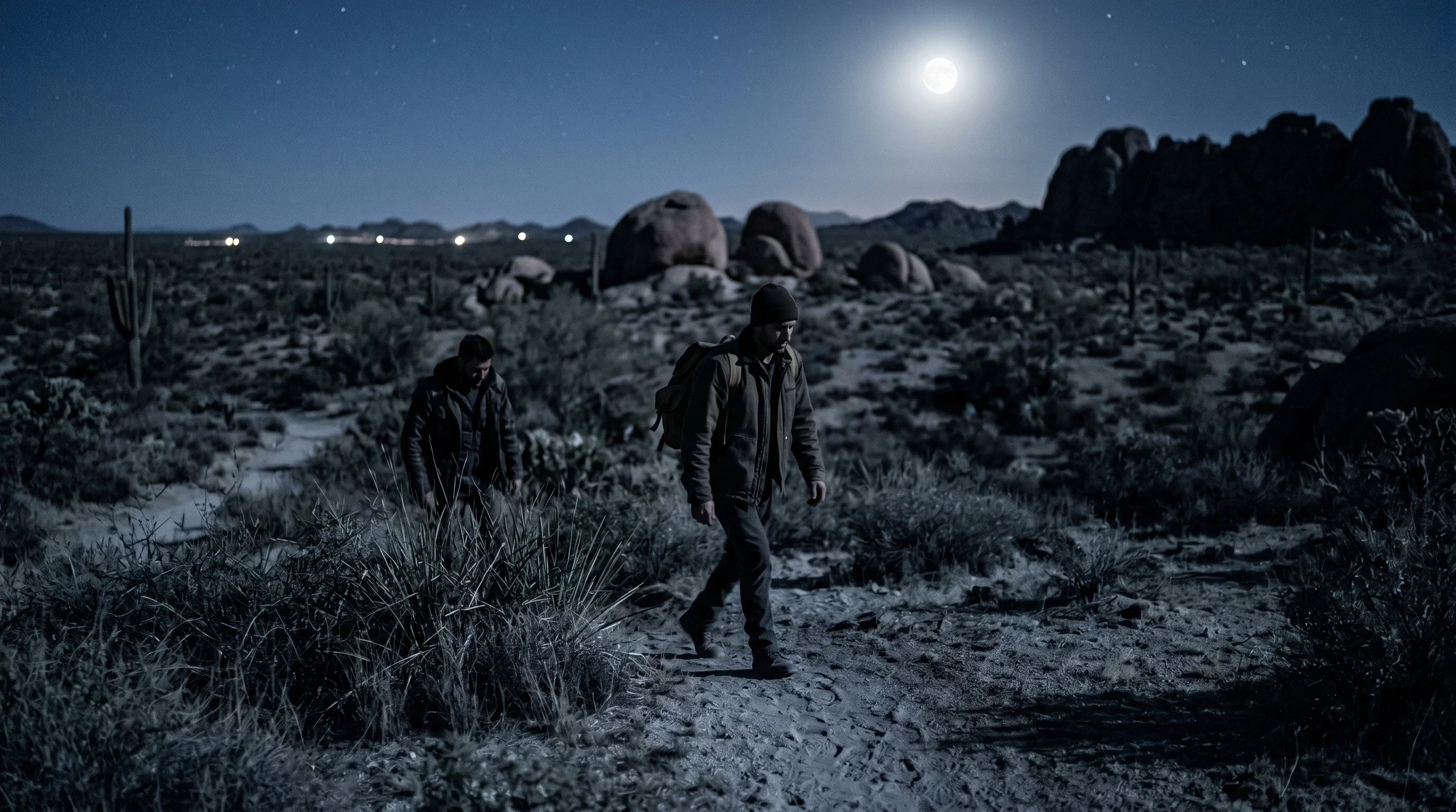
I was about five meters behind Quique as we walked north. Though it was after midnight, the desert was bathed in the moon’s cold light. The saguaros cast long shadows as they watched our progress. We’d been walking since nightfall; my feet ached, my head was pounding, and dusty air filled my lungs.
“Stay in the gravel,” I called to him.
“You’re so uptight, mano. There’s no one out here.” He’d been worrying a short stick he’d picked up, first stripping its bark, then peeling the fibrous stuff away in layers. But now he tossed it away and swore. More maddening, Quique sauntered along as though no one were watching, which wasn’t the case. The only rule, I told him, was always assume you’re being followed. Don’t leave a trace.
Quique stopped and set the leather satchel on the ground. He dug a pack of Marlboros out of his shirt pocket and lit one, taking a long draw, then he began trudging north again. The burning cigarette stood out against the dark sky like a meteor, and its thin, papery smoke was already reaching my nose.
I stumbled over something and almost fell face-first into a low cholla. My hand instinctively went to my Walther .380, tucked in my waistband. I had been watching Quique instead of my feet. Not a good plan.
“El operativo, bravo.” Quique turned and applauded. “How much further?”
The truth was I wasn’t sure. Two kilometers? But maybe it was five … or maybe ten. I’d lost all sense of distance in the dark. “Two clicks.”
“Sure.”
We put in three years of dogged surveillance to get the goods on this cartel. Now it all came down to a played-out operative and his informant meandering toward the U.S. border. And they weren’t just going to let us saunter away.
“I’m tired.” Quique sat on a boulder to the left of the path, groaning as he settled, all the while maintaining the ember on his cigarette.
“We’ve got to move. They’re coming, and that won’t end well for us.”
Quique laughed. “I know. I seen you shoot.” He lifted his T-shirt to show the scar from a bullet.
“You got in the way.” And he did. When I said stay down, Quique took that as a suggestion. You can’t fix that. I’d gotten us in and out of a lot of scrapes, but that was the nature of the business. Quique was along for the ride … and the money.
“Enough! Let’s book,” I said.
“Let’s just leave it for them. We’ll fight another day.”
“Throw away three years of work? Men died.”
Quique swore under his breath. “You told me, do the job, but don’t get attached.”
“I said that?”
“Know when to walk away.” Quique stood and held out the satchel at arm’s length, his eyes blazing with defiance. “That’s what you said.”
“Don’t.”
“Your words, Drummond.” Then, he wound up and flung the satchel into the desert. Except for the rustle when it landed, the darkness seemed to swallow it.
Quique took a long drag and stared at me, his face softer now, then turned and shuffled on.
A twenty-eight-year-old child. That’s what he was.
I rushed to where I heard the satchel fall, and after a few minutes of searching, I found it caught in a massive hackberry growth. The bag was still zipped tight; nothing had fallen out. And after a few scrapes and jabs, I had it under my arm. Safe.
I hurried after Quique. He was easy to follow, with his glowing cigarette, and he was walking straight down the middle of the trail, leaving prints so clear I could read the boot brand in the dust.
When I caught up, I called, “Veer left of that outcropping there.” I pointed to a grey silhouette about a hundred meters ahead.
“Sure. Whatever.” And Quique flicked the butt of his cigarette away into the night.
“Hey!” I tossed him the satchel, which he tucked under his arm. No commentary.
After half a mile or so, the terrain began to rise as we approached the outcropping, which now looked like a herd of grazing animals. A grove of young saguaros stood in our path.
Quique stepped carefully between two saguaros and moved on.
“Remember, left,” I said.
Then a tumble and a grunt, and Quique disappeared. I dashed through the saguaros and peered down into a deep ravine. The moon was low in the sky, and parts of the gully fell into deep shadows.
Quique had fallen about twenty meters down a steep slope and was lying at an awkward angle on the boulders at the bottom, like a discarded puppet. His dark silhouette looked so fragile, smaller than his five-five frame should have been. Or maybe I was tired.
Not two weeks ago, he’d said he was afraid, that it would all catch up to us, and bad things would happen. I told him not to worry. I got this, like I always did.
But now?
“Quique, you okay?”
“My leg’s wrecked,” he said, his voice weak and devoid of will. But alive.
“Stay there.” I began to feel my way down the slope, but the ground was shifty, causing me to slide while grasping at shrubs to slow my descent.
When I reached Quique, his eyes were closed. His leg was turned up under him in a way that it shouldn’t have been. Broken.
The satchel lay a few meters away.
And then I noticed a small puddle of blood beneath his head.
Moving next to him, I examined his scalp. There was a deep wound behind the ear where his head had struck a rock, and it was dripping blood at a steady rate onto one of the boulders.
“Quique.” I patted his cheek, and he opened his eyes.
“Hey, mano. Must have slipped.” He tried to get up and screamed in pain, falling back into me.
“That’s not going to work. Stay put.”
I should’ve taken the satchel and left him. He’d want me to. He’d be fine here for a few hours, till I could send help. Instead, I climbed back to the top of the ravine and began searching the desert for something, anything I could use for a litter. Then there was a buzzing, like an insect, yet far away. I turned to the south and saw it, or them. Bright dots over the horizon were bouncing along. Two dirt bikes, and a bit further back, a pickup. I estimated the bikes were less than five minutes away.
Now, I slid back down the slope at a reckless rate, almost crashing onto the boulders at the bottom, but I arrested my slide by grabbing a sole clump of scrub near the bottom. My hands were raw and my legs wobbly.
I bent over Quique and whispered, “They’re here. And this is going to hurt.”
He grabbed my arm. “Don’t forget.” He reached toward the satchel.
“I will come back for it.”
“But the stuff!”
“You first.”
I lifted his shoulders and pulled his limp body over the rocks. He screamed in pain, and a ringtail hiding in a crevice darted away down the ravine, its black striped tail flicking in the moonlight. I had to get Quique deeper into the shadows.
“One more time.” I pulled, and he shouted obscenities now. I remembered when we first met. I was surveilling a Nogales cantina when he picked a fight with a massive matón and ended up on the floor with a broken jaw and a dislocated ankle. I could hardly pull him out of there, I was laughing so hard.
And I laughed now, despite Quique’s injuries, despite the approaching men.
When my laughter died, we rested there in the dark, in the silence. The sky above us was immense, filled with millions of stars so clear and so real you could grab them. Only in the desert.
We sat together in a shallow crevice against the far slope of the ravine. Against my back was a huge piece of nearly vertical sandstone. The rock still held some heat from the sun, and it warmed me. Quique was leaning back on my chest, shivering, so I put my arms around him.
“Hush,” I whispered in his ear. He held his breath.
The two dirt bikes stopped at the edge of the ravine. Their lights were focused on the opposite rim, leaving the bottom in a patchwork of moonlight and shadows cast by the saguaros.
“Cut the engines,” a voice called, and the desert was plunged into a frightening silence.
That’s when I remembered the satchel, lying in the moonlight.
One of the riders shifted in his saddle.
“¡Silencio!” the other barked. “And cut the lights. I can’t see.”
Their headlamps blinked off.
Quique was trying to breathe slowly, noiselessly, but his chest was starting to heave with the strain. I covered his mouth with my hand. His lips were quivering.
Just then, the pickup skidded to a stop at the edge of the ravine, blowing up a dusty haze. The door opened, and a man’s boots landed on the ground. I counted three of them now, but I was unsure; their forms were moving among the silhouettes of the saguaros.
“Why’d you stop?” the driver asked. A voice I knew, Bozada. One of Garza’s lieutenants, and he’d remember me. I made sure of that when I put a knife through his hand.
“I heard a noise … like someone screaming.” The second biker. His voice was young, probably a teenager.
“Mmm.”
Bozada chuckled, then all went still, long enough for the sound of a single chirping insect to emerge from the quiet.
A flashlight came on. The blinding beam fell on the boulders about fifteen meters down the ravine. The light began sweeping back and forth across the slopes and moving toward us.
“What’s that?” Bozada asked.
The light stopped.
“Back a bit.”
Quique’s blood on the boulder.
“There on that rock. Go down and check it out.”
I drew my .380 and flipped off the safety, and my training kicked in.
But the young one laughed nervously. “It’s nothin’. Just blood from a yote kill.”
The satchel still sat where it had fallen, just beyond the beam of the flashlight.
Then something moved further down the ravine. The beam swung away and up the dry bed in the direction the ringtail took.
“See? Just some vermin.”
Bozada gave a light chuckle.
Quique was gripping my wrist almost to the point of pain, holding my hand tight to his mouth.
Another minute.
“¡Vámanos! They must be up ahead.”
The light clicked off, and the motors sprang to life along with the headlights. The truck door slammed, and the vehicles sped off.
Quique’s breathing slowed, and he let out a deep cough. The front of my shirt was warm. Quique’s blood.
“You doin’ okay?” I whispered.
He nodded his head.
“I’m going to get the bag. Then we can figure out how we get out of here.”
Quique reached up and grabbed the collar of my shirt.
“Easy, mano,” I said. “I’ll be right back.”
He pulled me down and put his mouth to my ear. “No,” he choked and pointed to the top of the ravine.
Quique wouldn’t let go of my shirt.
“They left.” I tried to pull away, but he held tight.
“Cigarette.” He pointed again to the edge of the ravine.
But there was nothing there. Just the saguaros. I pried at his fingers, and finally, he released me.
I met his frantic eyes and put my hand on his shoulder. “I’m coming back.”
Quique let out another low cough, and I glanced up again at the ridge. All clear.
Struggling over the boulders, I made my way toward the satchel, my pistol still drawn. The bag must have fallen into the shadows now because I couldn’t spot it. I crouched down and began feeling my way along the rocks in the darkness, when finally my hand fell on the oiled leather.
I wrapped my hand through the strap.
And in that moment, a blaze of light. A thunder of sound. I was thrown back. Something hit my chest.
On the edge of the ravine. More flashes. Rocks splintered around me.
I raised my gun and emptied the magazine at the edge of the ravine. Then, empty clicks.
I stopped.
Acrid smoke. Cold moonlight. Nothing moved.
Breathing hard. An oozing hole in my chest.
I dropped my arm.
Suffocating tightness. Thunder still ringing in my ears.
On the ridge, a glowing ember among the saguaros. A chuckle.
“Drum! You hurt?” Quique.
Stand. Need to stand.
My hand caught. The leather strap.
The satchel.
I pulled. But no.
Sliding sounds. Dust.
Foot falls.
The ember. Smoke. Over me.
“I’ll take that.” The satchel. “Sad.”
Bozada. Not angry. Sad.
No breath.
The stars were gone, the ember gone. My eyes were closed.
“Drum!” Quique.
I should answer, but I had no breath.
✧ ✧ ✧
As an Advance Reader for this story, you have the opportunity to tell me what you think. Please take a moment and complete the short feedback form. Your anonymous input will help me shape the next draft of this story!
This story is a work of fiction. Except where explicitly identified in the afterword, the names, characters, and incidents herein are a product of the author’s creation and any resemblance to actual persons or events is entirely coincidental.
DESERT CROSSING. Text copyright © 2026 by Mark Mrozinski LLC. All rights reserved.
No part of this work may be reproduced, stored in retrieval systems, or transmitted in any form or by any means, electronic, mechanical, photocopying, recording, or otherwise, without the express written permission of the author.